From 1 KB of RAM to modern computing — one computer at a time.
My computing journey began back when a kilobyte of memory was something you had to work around, not a rounding error in a system requirements document.
I’ve spent decades exploring computers, programming, gaming and technology. Along the way, I’ve used a collection of home computers that chart an extraordinary period in technological history. From the humble Sinclair ZX81 to the 16-bit power of the Atari ST and Commodore Amiga 500, each machine brought new possibilities, new frustrations and the occasional urge to throw something through a window.
This series is a personal journey through the evolution of home computing, told from the perspective of someone who was actually there, pressing the keys, writing the code, loading the tapes and discovering what these machines could do.
We’ll get technical, too. We’ll look at processors, memory, graphics, sound, storage, programming and the clever engineering that squeezed so much out of such limited hardware. We’ll explore the games, the innovations, the rivalries and the occasional technological disaster that helped shape the computers we use today.
But this isn’t going to be a dry history lesson. I’ll be adding my own memories, opinions and the odd bit of Gramepa-style commentary along the way. Because nostalgia is all very well, but let’s be honest: some of those machines were brilliant, some were gloriously eccentric, and some made you question your life choices while a cassette tape screeched away for twenty minutes before failing to load.
Follow the timeline to explore the machines I’ve used, discover how home computing evolved, and see just how far we’ve travelled from those early experiments to the technology we take for granted today.
Welcome to the chronicles. Mind the loading tape.
The early years:
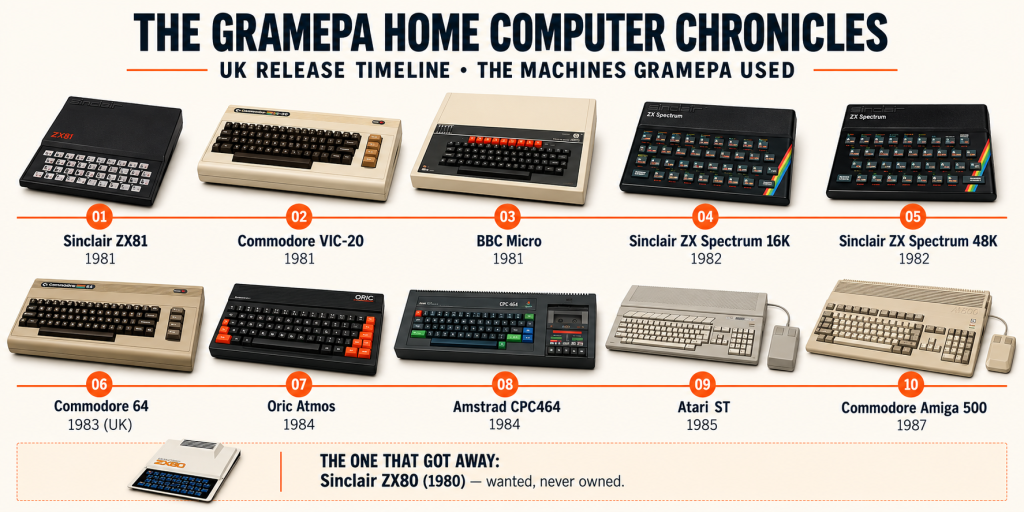
What really strikes you when you look at this timeline is just how bloody fast everything moved. Between the Sinclair ZX81 arriving in 1981 and the Commodore Amiga 500 in 1987, we went from machines with 1 KB of RAM, monochrome displays and the ability to make a television look vaguely interesting, to computers capable of sophisticated colour graphics, stereo-like sound effects, multitasking and games that felt like stepping into another world.
In barely six years, home computing went from a curious hobby for people willing to get their hands dirty with BASIC programming to a serious entertainment platform that could compete with, and sometimes outperform, dedicated arcade and gaming systems. Every new machine seemed to raise the bar, whether through more memory, better graphics, improved sound or entirely new ways of interacting with a computer.
And the really astonishing thing? This wasn’t a gentle, predictable march of progress. It was a technological arms race played out on shop shelves, in bedroom coding sessions and around kitchen tables across Britain. Sinclair, Commodore, Acorn, Oric, Amstrad and Atari were all trying to convince us that their machine was the one to own. Buy a computer one year and, before you’d finished learning all its tricks, something newer and more capable was tempting you to empty your wallet again.
For those of us who lived through it, this was more than technological progress; it was an exhilarating period when the future seemed to arrive every few months, and you never quite knew what these little plastic boxes would be capable of next. And we haven’t even got to the 1990s yet.