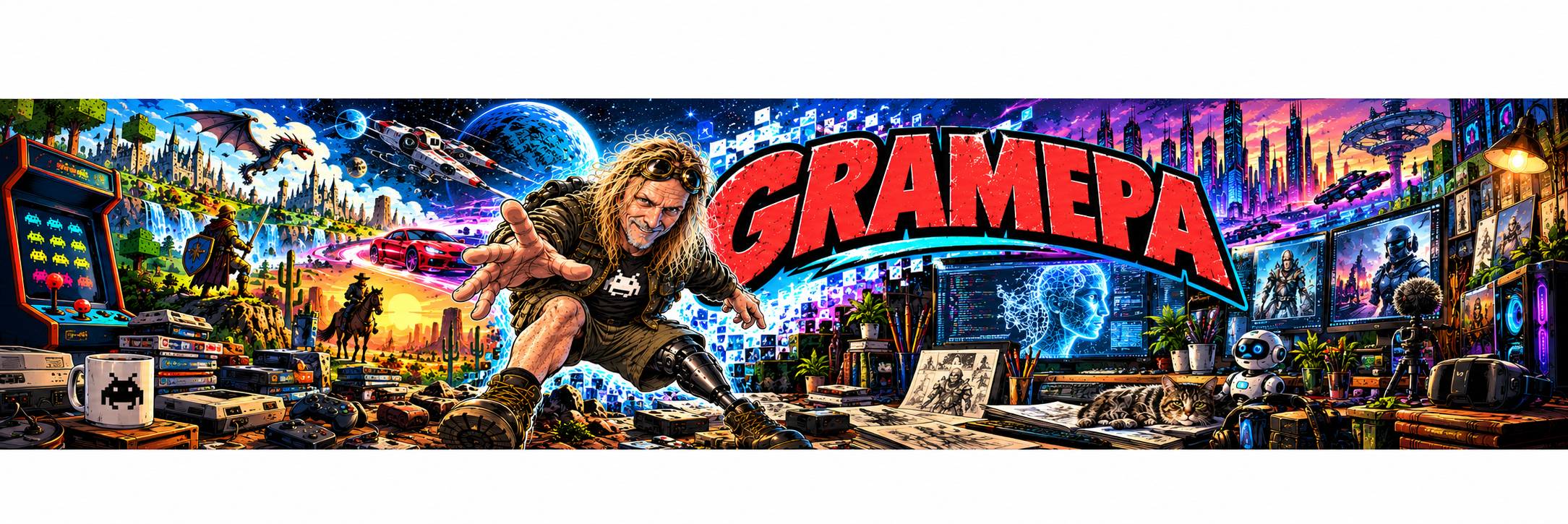
What happens when you give an AI a creative framework, automate the process, and deliberately stop telling it what happens next?
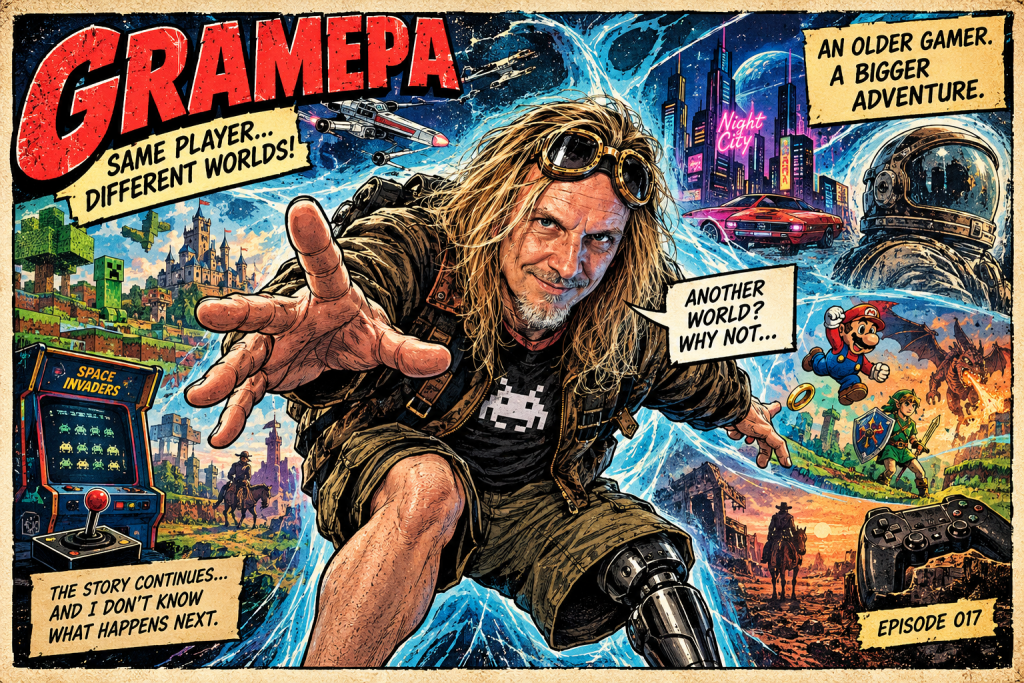
I’ve been messing around with computers and technology for a very long time.
Long enough to have written programs in BASIC on a Sinclair ZX81, watched gaming evolve from Pong to photorealistic open worlds, worked as an arcade engineer and manager, taught ICT and Business, and eventually ended up doing things with artificial intelligence that would have sounded like science fiction when I was younger.
So when I started experimenting with AI-generated creative projects, I wasn’t particularly interested in asking it to write me another business email.
I wanted to see what happened if I gave it something a little more interesting.
Something slightly ridiculous.
Something that could, potentially, keep going forever.
That experiment became Gramepa.
So, What Is Gramepa?
Gramepa is a fictionalised version of me. Another of my projects is www.gramepa.com where I play around with tech and video games and I post all manner of random bits and bobs relating to those subjects.
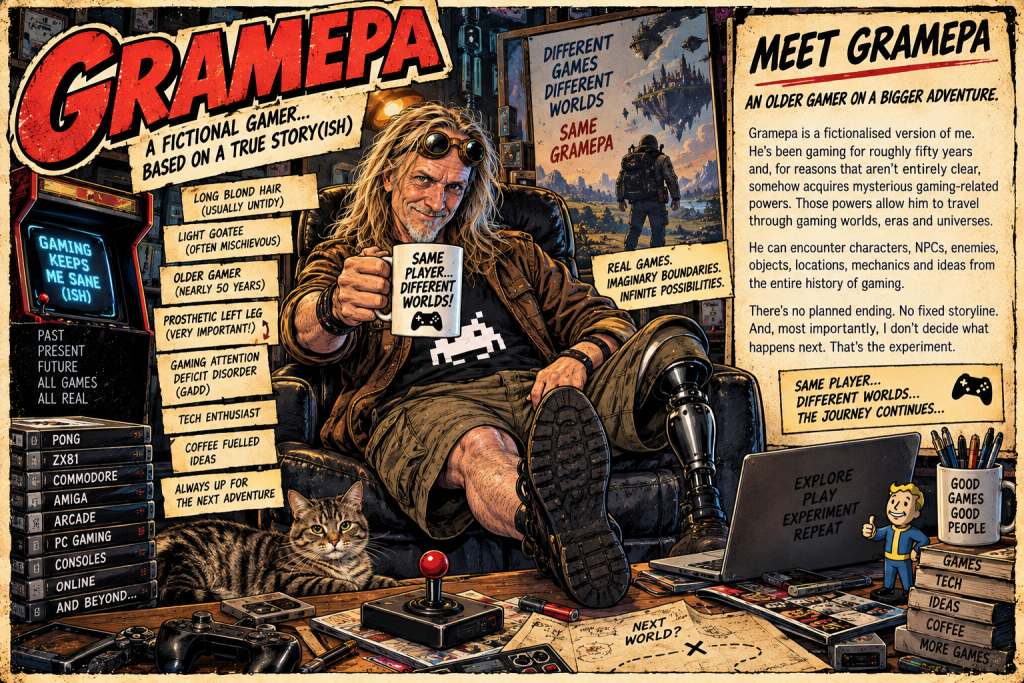
Gramepa is an older gamer who has been playing games for roughly fifty years and, for reasons that weren’t entirely clear at the beginning, somehow acquires mysterious gaming-related powers.
Those powers allow him to travel through gaming worlds, eras and universes.
And that is where things get rather silly.
Gramepa can potentially encounter characters, NPCs, enemies, objects, locations, mechanics and ideas from the entire history of gaming.
There are very few limits to where the story can go.
It can be funny.
It can be surreal.
It can be ridiculous.
It can occasionally make absolutely no sense whatsoever.
But there is one very important rule:
The story has to remember what happened yesterday.
There is no planned ending.
There isn’t even a planned storyline.
And, perhaps most importantly, I don’t decide what happens in the next episode.
That’s the experiment.
I Didn’t Want to Write a Comic
At first glance, this might sound like an ordinary AI image-generation project.
Give AI a character.
Give it a prompt.
Ask it to make a comic.
Job done.
That wasn’t really what I was interested in.
I wanted to create something that could continue.
A story that could develop from one day to the next, with characters and events carrying forward.
And I wanted to remove one particular part of the creative process from myself.
The decision about what happens next.
So I established the framework.
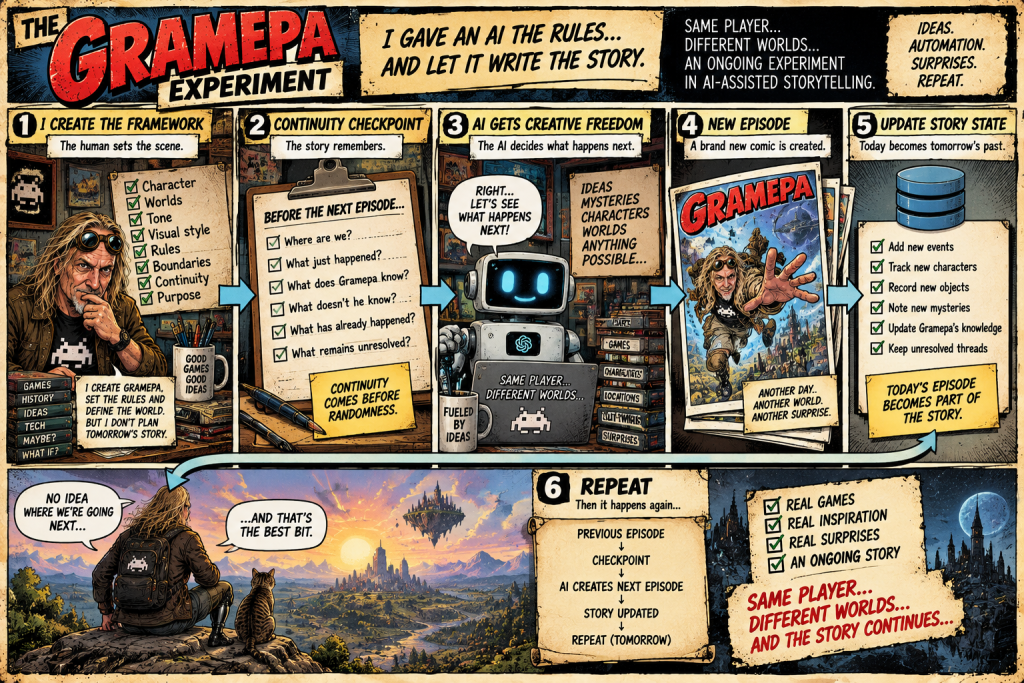
I created the character.
I established the rules.
I decided on the tone.
I established the visual direction.
I defined what sort of world Gramepa could inhabit.
I explained the importance of continuity.
And then I gave the AI room to make the next creative decision.
I deliberately didn’t give it tomorrow’s storyline.
I didn’t tell it:
Tomorrow Gramepa meets this character.
Or:
Tomorrow this particular thing happens.
Or:
Tomorrow the story needs to move in this direction.
Instead, the system looks at what has already happened, considers the current state of the story and creates the next episode within the framework I’ve established.
Then it happens again the following day.
And again.
And again.
Which means that, rather unusually, I don’t know what happens next either.
This Isn’t AI Creating a Comic Without a Human
This distinction matters.
There is sometimes a tendency to talk about AI-generated work as though the human simply pressed a button and wandered off for a cup of tea.
That’s not what is happening here.
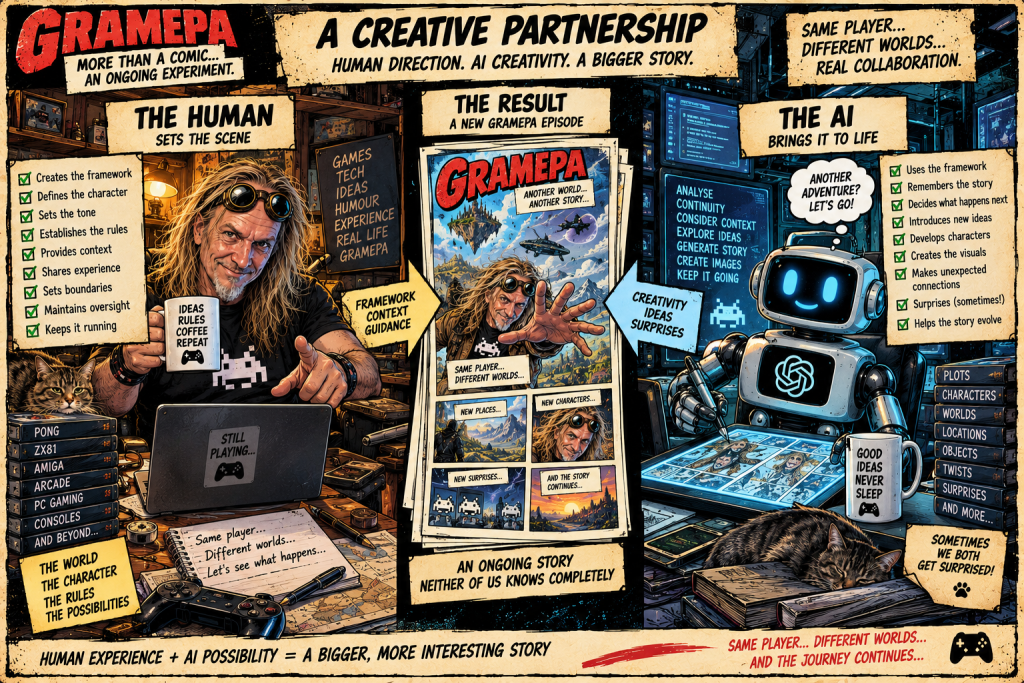
I created the creative framework that makes Gramepa possible.
I decided:
- who Gramepa is
- what his world can contain
- how the story should behave
- what sort of tone it should have
- what the visual style should feel like
- what the boundaries are
- how continuity should work
- and what the experiment is actually trying to discover
The AI is operating inside that framework.
So I wouldn’t describe this as AI replacing the creator.
It is much closer to human-directed, AI-assisted creative collaboration.
Except that one of the collaborators is rather unpredictable.
And doesn’t have to be told what the next episode should be about.
But There’s Another Influence on Gramepa
There is another influence on Gramepa that is perhaps less obvious.
The character isn’t based solely on a fixed document of instructions that I wrote at the beginning of the experiment.
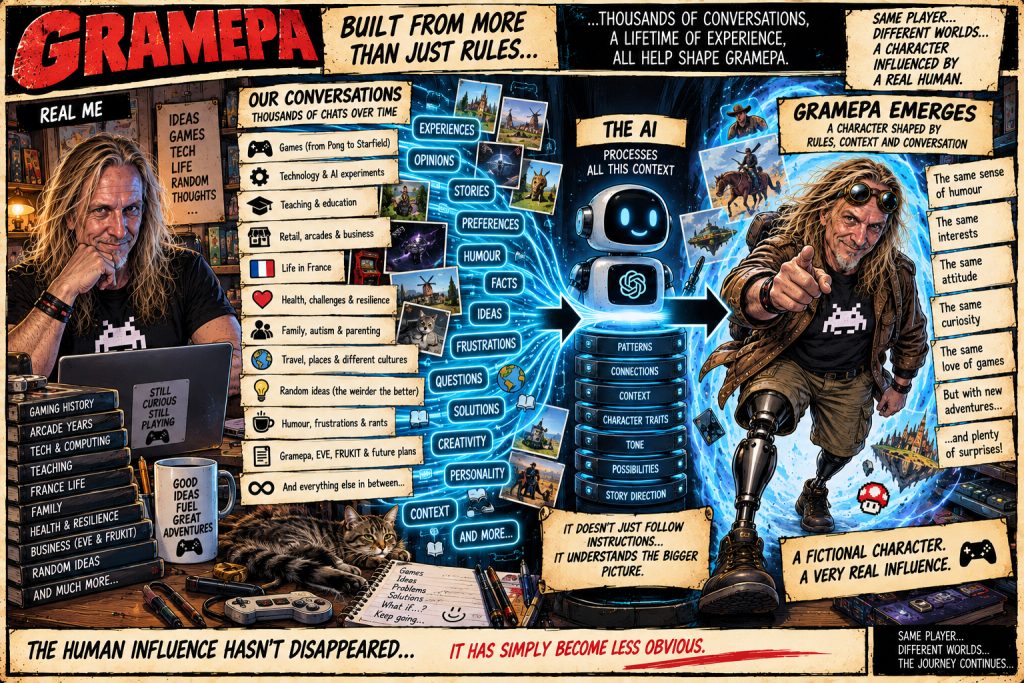
Over the course of working with AI, I’ve had thousands of conversations about games, technology, my experiences, the sort of things I find amusing, the sort of things that irritate me, and the general collection of odd ideas that make up the Gramepa universe.
That history can also influence the way Gramepa develops.
So, in a slightly strange way, the AI isn’t just working from a description of Gramepa.
It has also been given a considerable amount of context about the person Gramepa is based on.
That doesn’t mean the AI is secretly creating a psychological profile of me and turning it into comic-book material. It means that the accumulated context from our conversations can help shape the character, the humour, the situations and sometimes the direction in which a story feels appropriate to Gramepa.
In other words, some of the character development comes from the rules I deliberately wrote, while some of it comes from the accumulated context of the conversations that have helped build the project.
I find that rather fascinating.
Because it means that even though I’m deliberately surrendering some creative control, I’m still influencing the experiment in ways I don’t necessarily see happening at the time.
The human influence hasn’t disappeared.
It has simply become less obvious.
The Most Important Rule: Continuity Comes Before Randomness
This turned out to be one of the biggest challenges.
AI is very good at producing something interesting.
It is considerably less impressive if yesterday’s events suddenly cease to exist because today’s prompt has wandered off in another direction.
An ongoing story needs memory.
It needs to know where the character is.
It needs to know what has happened.
It needs to know which characters have appeared.
It needs to know what objects have been discovered.
It needs to know which mysteries have been introduced.
It needs to know what Gramepa knows.
And, just as importantly, it needs to know what Gramepa doesn’t know.
Otherwise, the whole thing quickly becomes a collection of disconnected episodes rather than a story.
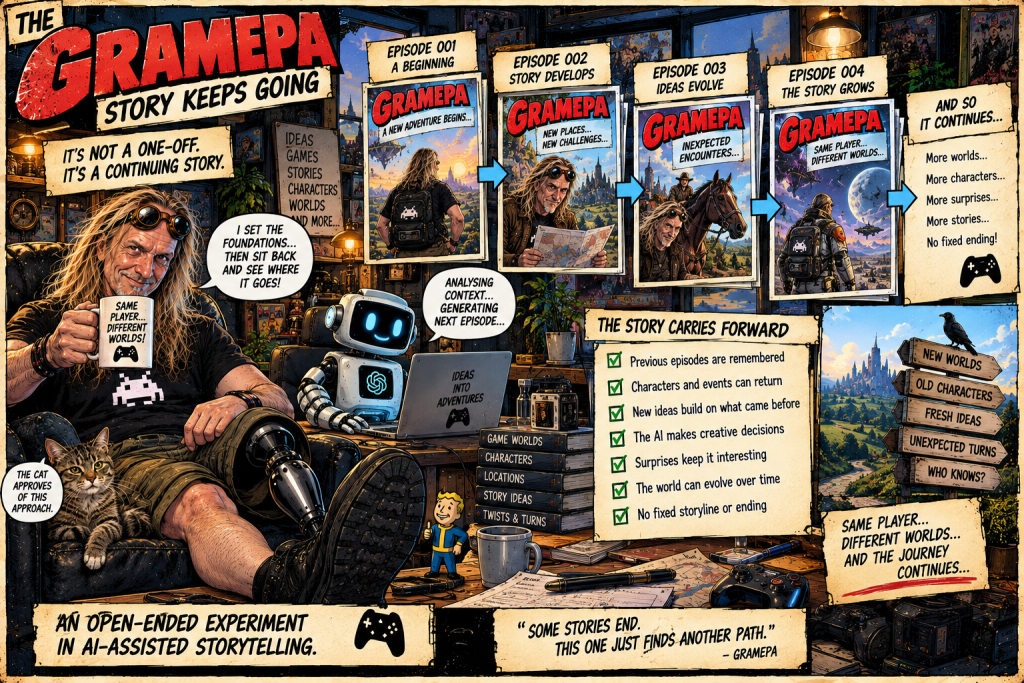
So we’ve developed a sort of continuity checkpoint before each new episode.
The process essentially asks:
Where are we?
Where is Gramepa at the beginning of this episode?
What just happened?
What was the immediate result of the previous episode?
What does Gramepa know?
What information has the character actually acquired?
What doesn’t Gramepa know?
What information remains a mystery to him?
What has already happened?
Which characters, objects, locations and events are established parts of the story?
What remains unresolved?
Are there any mysteries, problems or story threads that should still be hanging around?
Only after that comes the next creative decision.
The principle is simple:
Continuity comes before randomness.
The AI is allowed to surprise me.
It isn’t allowed to simply forget yesterday.
And Then Something Rather Interesting Happened
Once the process started working, I noticed something I hadn’t really expected.
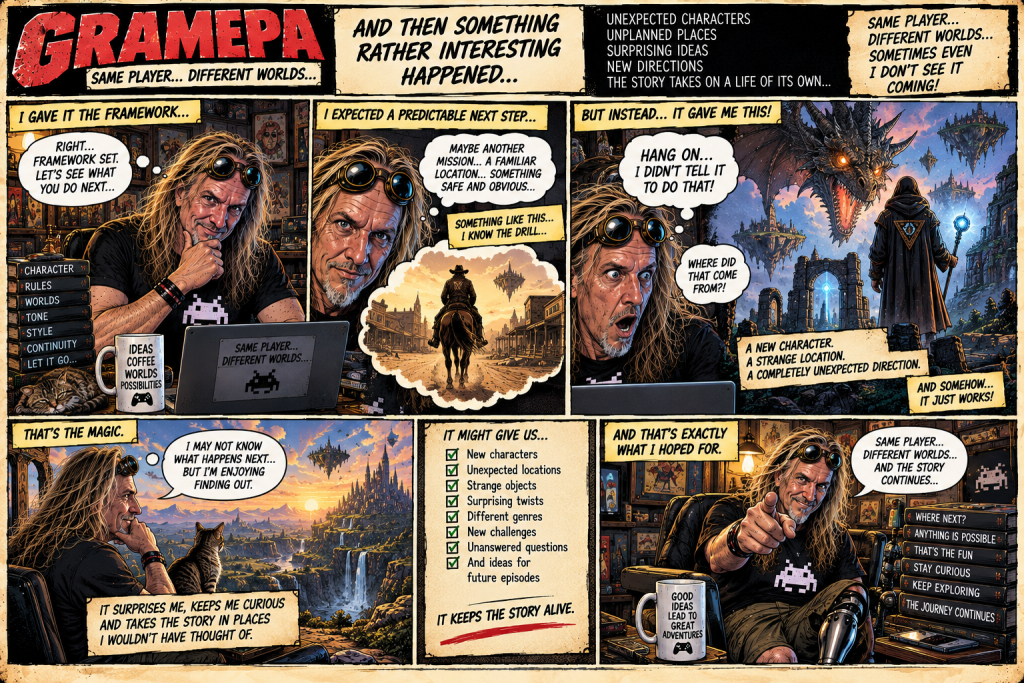
The AI began introducing things that I hadn’t specifically asked it to introduce.
Characters appeared.
Objects became important.
Mysteries emerged.
Story elements were carried forward.
Something that seemed relatively minor could become relevant later.
And occasionally the story would head in a direction that simply wouldn’t have occurred to me.
That’s the bit I find particularly interesting.
Not because I believe the AI has somehow become an independent storyteller with its own imagination.
It hasn’t.
It is generating material according to the framework, information and instructions it has been given.
But the specific creative decision being made at that moment wasn’t made by me.
And that changes the experience.
I’m no longer sitting there thinking:
“Right. What should happen next?”
I’m sitting there thinking:
“Right. What has it decided should happen next?”
And sometimes the answer is:
“Oh. That’s interesting.”
And sometimes it’s:
“Well, that’s bloody weird.”
Both are useful outcomes.
The Strange Pleasure of Not Knowing
This is probably the part of the experiment I enjoy most.
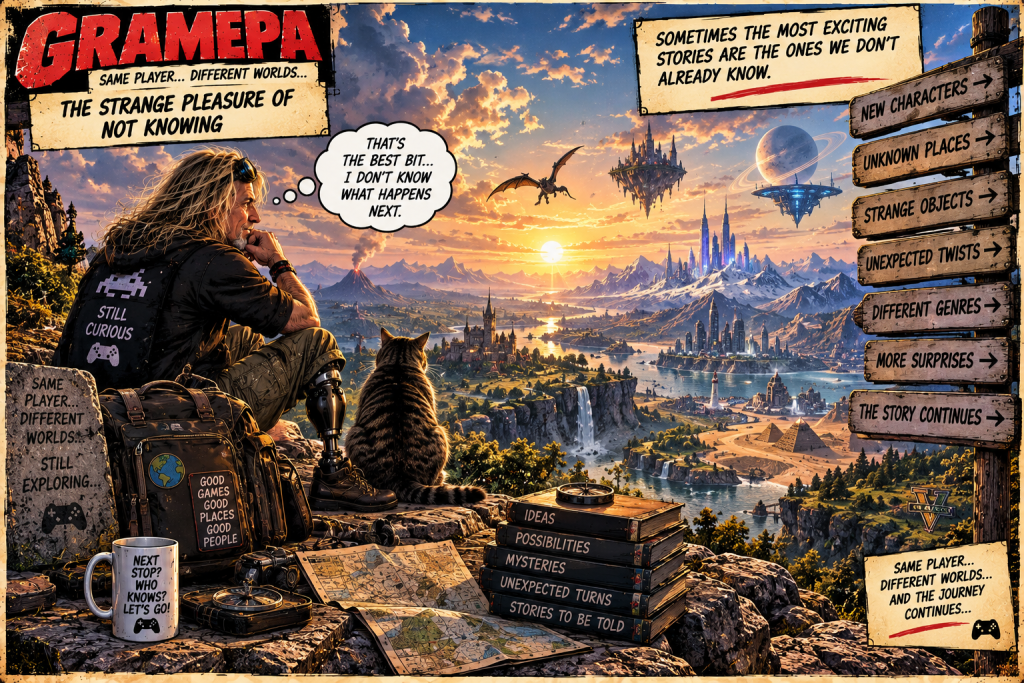
I don’t know what tomorrow’s comic will contain.
I know the rules.
I know the character.
I know what has happened so far.
I know the current story situation.
But I don’t know what the next episode will do with it.
That introduces something that is surprisingly difficult to create in a normal creative project:
uncertainty.
When you’re writing your own story, you generally know where you’re going.
Even if you change your mind halfway through, there is still a human behind the steering wheel.
With Gramepa, I’ve deliberately taken my hands off the steering wheel.
I’m still sitting in the car.
I’ve built the car.
I’ve chosen the road system.
I’ve put up some rather important traffic signs.
But I’m not choosing every turn.
And that’s what makes it fun.
Of Course, It Doesn’t Always Work Perfectly
It would be rather dishonest to present this as some magical demonstration of flawless AI creativity.
It isn’t.
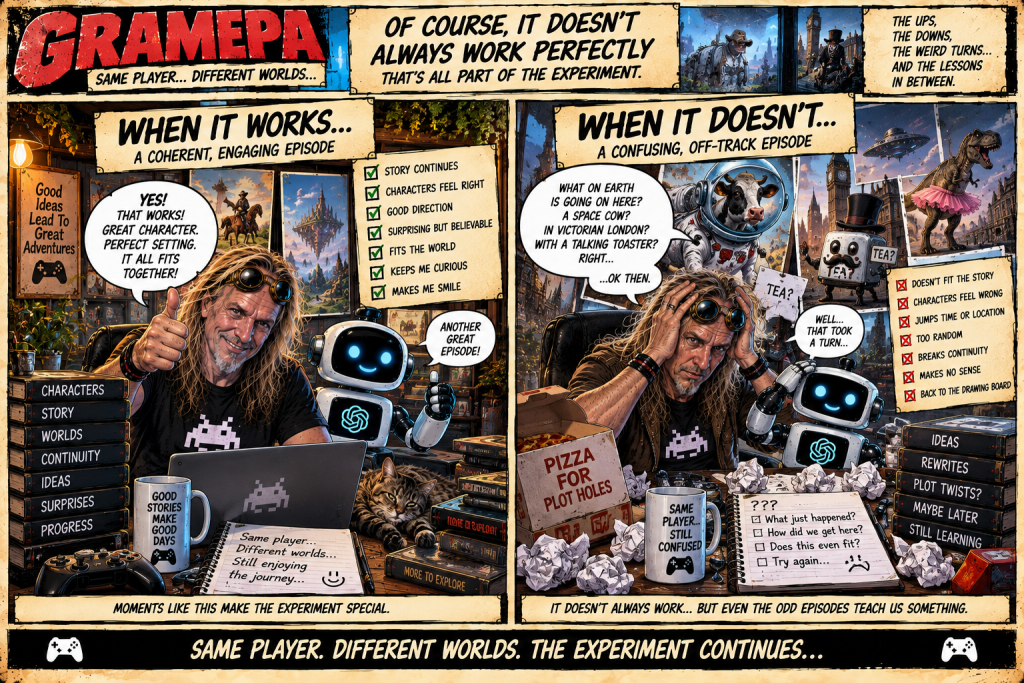
There are mistakes.
There are occasionally continuity problems.
There can be visual inconsistencies.
Sometimes an idea works beautifully.
Sometimes it doesn’t.
Sometimes the AI takes something in an unexpected direction and the result is genuinely entertaining.
Sometimes the result is simply… well… AI being AI.
That’s part of the experiment too.
I’m not trying to prove that AI is perfect.
I’m trying to find out what happens when it is given a structured creative job with room to make decisions of its own.
If something goes wrong, that tells me something about the system.
If something works particularly well, that tells me something too.
The failures aren’t evidence that the experiment has failed.
They’re part of the experiment.
Why Automate It?
This is another important part of the project.
I could simply create a new comic manually every day.
But that would change the experiment.
The whole point is to remove as much of my day-to-day creative decision-making as possible.
The automated process allows the next episode to be generated without me sitting down each morning and inventing a new storyline.
That makes the project much closer to an ongoing system rather than a collection of individual creations.
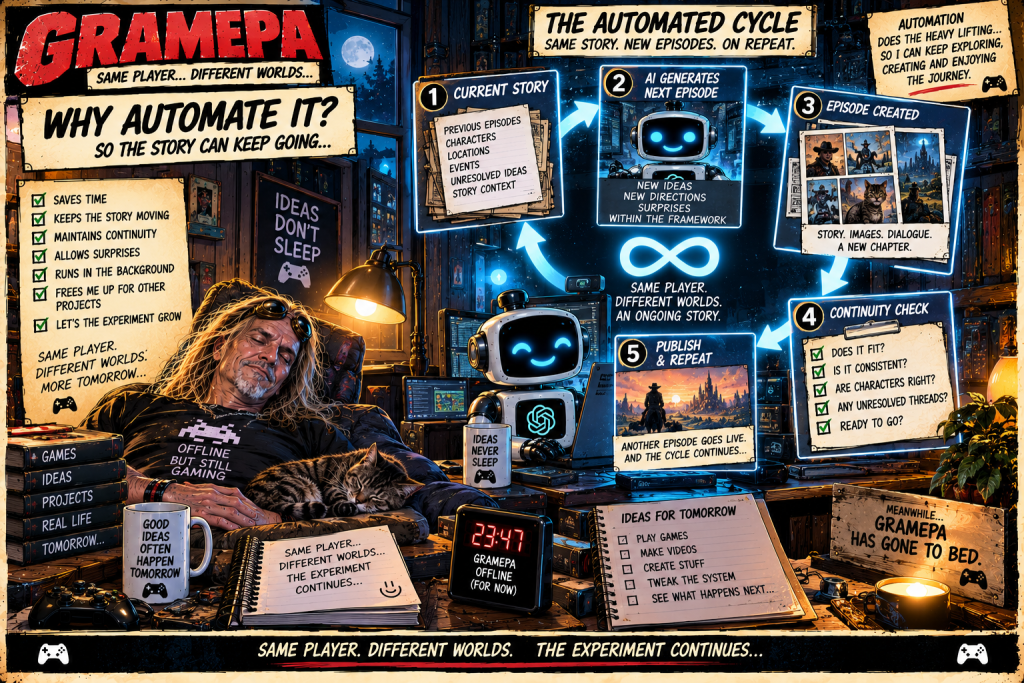
The basic idea is something like this:
Previous episode
↓
Continuity checkpoint
↓
AI determines the next story beat
↓
New episode
↓
Updated story state
↓
Next day’s episode
And then it starts again.
There is no final episode sitting in a folder somewhere waiting to be revealed.
The story is simply continuing.
Hang on, there’s a thought… Maybe I could get it to continue beyond my Game Over if I can set it to auto post…
So What Is the Experiment Actually Testing?
I’m not trying to prove that AI can replace writers.
I’m not trying to prove that AI is secretly creative.
And I’m certainly not trying to prove that computers are about to take over the comic-book industry.
That would be rather more dramatic than the evidence currently supports.
What I’m interested in is a much simpler question:
What happens when you give AI a creative framework and then deliberately give it enough freedom to surprise you?
That’s a different proposition.
The human establishes the environment.
The AI operates within it.
Automation keeps the process moving.
Continuity keeps the experiment coherent.
And the unexpected decisions become the interesting part.
Why I’m Doing This Through FRUKit
FRUKit is ultimately about helping people use technology with confidence.
That doesn’t mean using technology simply because it’s new.
And it certainly doesn’t mean throwing AI at every problem because somebody on the internet has announced that AI is going to change everything before Tuesday.
Technology is useful when it solves a problem, makes something possible, or gives us an opportunity to do something interesting.
The Gramepa experiment is a good example of the last one.
I couldn’t realistically sit down every day for years and manually write, illustrate and maintain continuity for a never-ending gaming comic.
Automation and generative AI make that sort of experiment practical.
More importantly, it has given me a way of exploring what AI can do without pretending that it is magic.
There is a human framework.
There are rules.
There is automation.
There are failures.
There is human oversight.
And there is a healthy amount of:
“Let’s see what happens.”
That’s very much the sort of technology experimentation that interests me.
What Have I Learned So Far?
The experiment is still running, so I’m not going to pretend that I have some grand conclusion after which the curtain comes down and the scientific paper gets published.
But a few things have already become apparent.
AI creativity benefits from boundaries
Giving an AI unlimited freedom isn’t necessarily useful.
Giving it a framework within which it can make unexpected decisions seems considerably more interesting.
Continuity is harder than generation
Creating another image isn’t particularly difficult.
Creating another image that makes sense because of everything that came before it is a much more interesting problem.
Human involvement doesn’t disappear
It changes.
Instead of making every creative decision, the human increasingly becomes the person who establishes the environment, monitors the process and decides when something needs correcting.
Automation changes the experiment
Once the process is automated, it becomes possible to observe what happens over time rather than simply producing a series of individual AI creations.
Not knowing can be surprisingly useful
Perhaps the biggest lesson is the simplest one.
Sometimes giving up a little creative control doesn’t reduce the fun.
It increases it.
And I Still Don’t Know What Happens Next
That’s probably the strangest thing about the whole project.
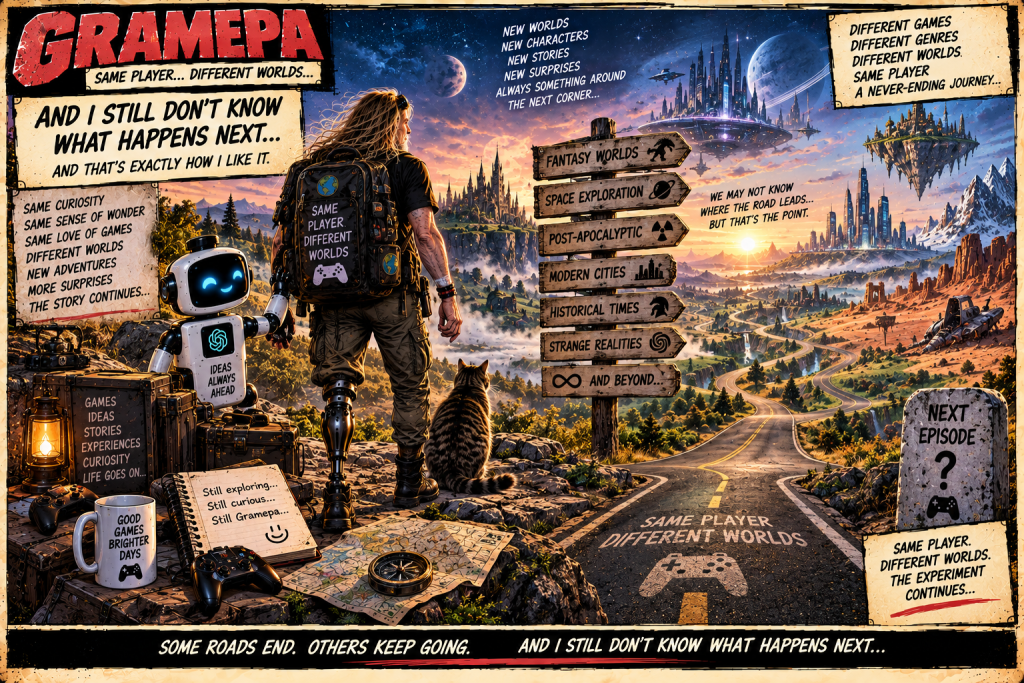
I created Gramepa.
I created the rules.
I created the framework.
I set the thing running.
But I haven’t written the ending.
In fact, I haven’t written tomorrow.
And tomorrow’s episode might introduce something completely unexpected.
It might create a brilliant new character.
It might resurrect something from earlier in the story.
It might open a new mystery.
It might produce something completely ridiculous.
I genuinely don’t know.
And for once, that’s exactly what I wanted.
The experiment isn’t really about asking:
“What can AI create?”
It’s about asking:
“What happens when I create the conditions for AI to surprise me?”
Perhaps the strangest part of the experiment is that I’m not actually outside it.
Even when I stop deciding what happens next, everything I’ve already brought to the project continues to influence where it goes.
The character, the humour, the experiences, the gaming history, the rules and all those conversations that helped shape Gramepa are still there in the background.
The human influence hasn’t disappeared.
It has simply become less obvious.
So for now, I’m going to leave Gramepa to it.
I’ve got no idea where he’s going.
Which, considering I invented him, seems rather appropriate.
Follow the comic series here: https://www.gramepa.com/category/the-gaming-time-machine/
About FRUKit
FRUKit helps English-speaking individuals and small businesses in France use technology with greater confidence.
The aim isn’t to use technology simply because it is new and shiny. It’s to understand what it can actually do, work out whether it is useful, and then use it sensibly.
Sometimes that means solving a practical problem.
Sometimes it means making technology a little less intimidating.
And occasionally, apparently, it means giving an AI an elderly gamer with mysterious powers and seeing what happens.
Find out more about FRUKit here: www.frukit.com